Forex Market Learning Index
Structured educational pathway from global macroeconomic fundamentals to institutional interbank price action.
Foundation & Chart Analysis
5 ModulesForex Market Basics
Currency pairs, exchange rates & pips
Candlestick Patterns
Pin bars, morning stars & rejection candles
Chart Patterns
Channels, double bottoms & flag breakouts
Market Analysis
Central banks, interest rates & technicals
Support & Resistance
Key psychological exchange rate barriers
Currency Derivatives & Interbank Flow
4 ModulesSupport & Resistance in Forex
Support and resistance are the fundamental building blocks of technical analysis and price action in currency markets. Learn to identify high-liquidity price floors and ceilings to execute precision entries, stops, and targets.
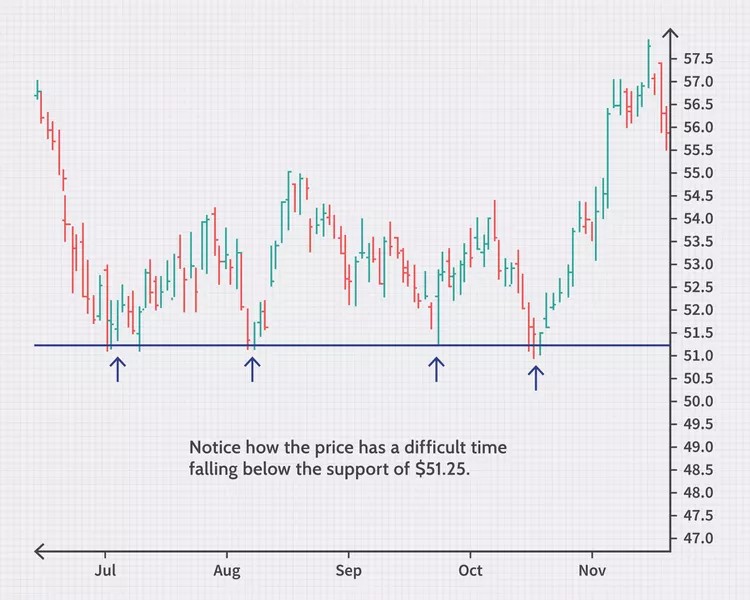
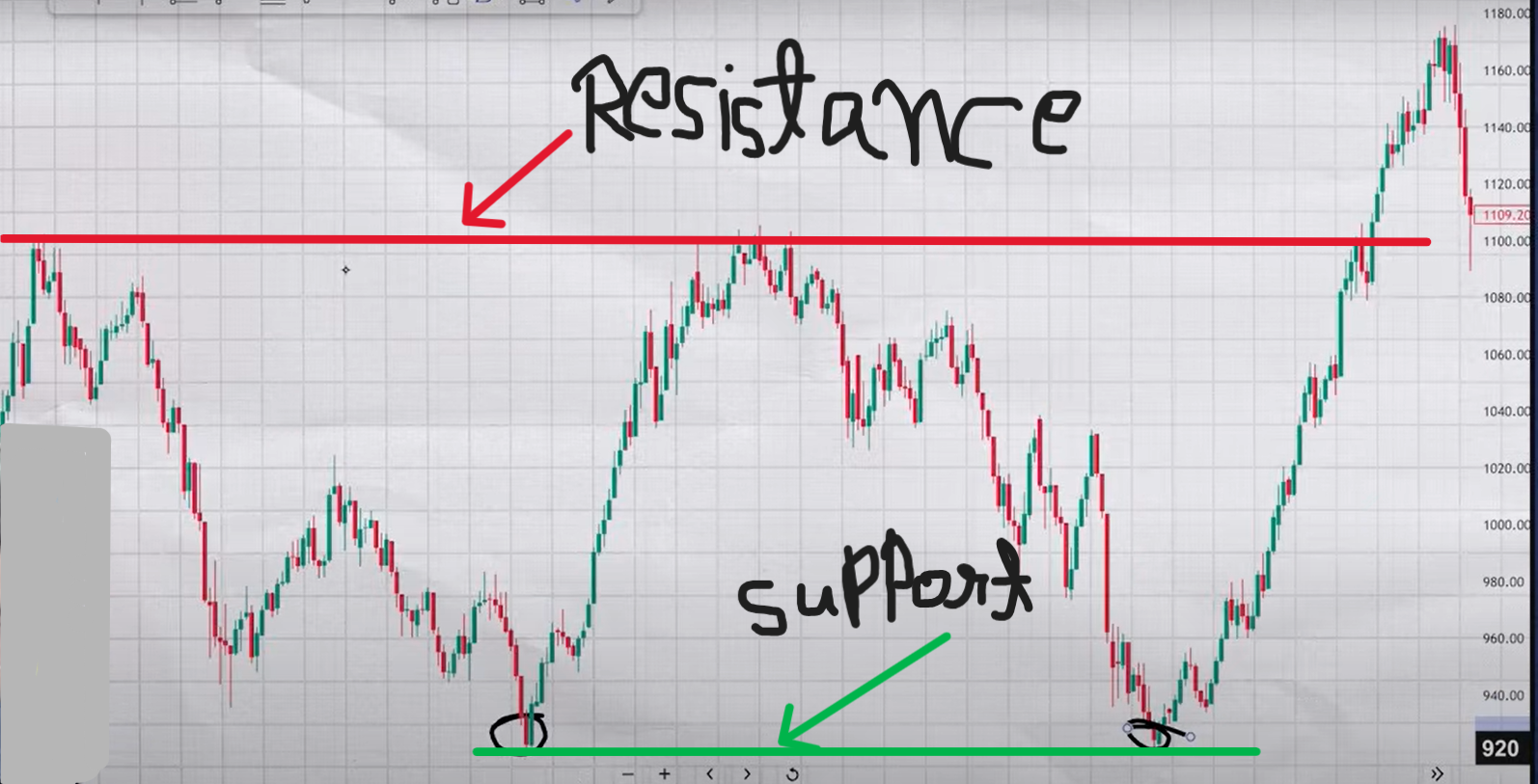
Support Zone
A price level where a currency pair tends to stop falling and bounce upwards. Institutional bank buy orders cluster here, absorbing sell volume and reversing downtrends.
- Acts as a barrier/floor preventing lower pip quotes
- Formed at historical swing lows and major psychological figures (e.g. 1.0800 EUR/USD)
- Traders use support tests to enter long trades with tight stops beneath the floor
Resistance Zone
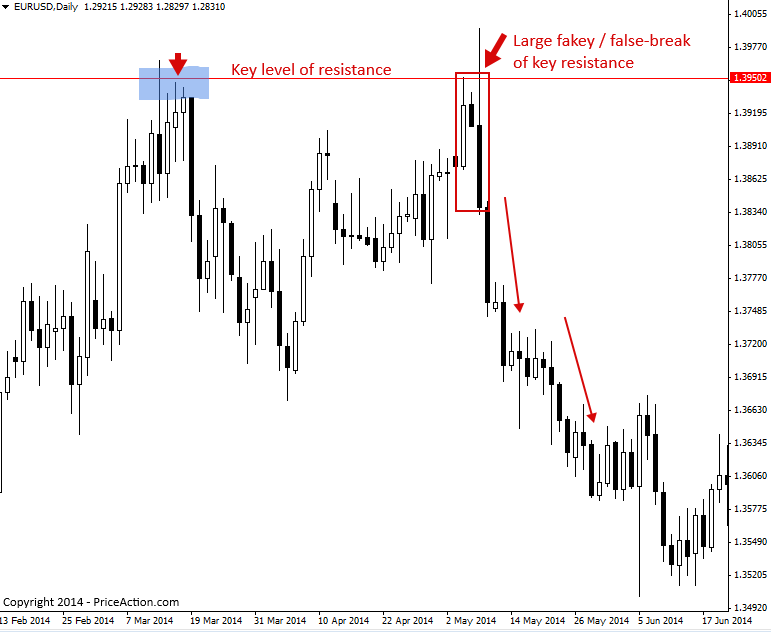
A price level where a currency pair tends to halt rising and reverse downwards. Institutional selling orders overwhelm demand, capping upward pip progress.
- Acts as an overhead ceiling preventing higher prices
- Formed at previous swing highs and distribution supply pools
- Traders utilize resistance tests to take profits or initiate short trades
Trend Reversal
Price hits an established support or resistance boundary and turns in the opposite direction due to limit order absorption.
Breakout / Breakdown
Price breaches support or resistance with volume momentum, signaling the start of a strong trend continuation impulse.
Role Reversal (Flip)
Once an old resistance ceiling is broken, it flips into new support floor on the retest (and broken support becomes resistance).
How to Draw Error-less 100% Accurate Support and Resistance
Precise rules for plotting valid institutional zones in forex trending vs range-bound markets
Define Time Frame
For general forex trading, use the 15-minute or 1-hour interval for intraday, and 4H/Daily for swing setups.
Pre-Built Indicator
Select indicator: 'Swing High Low' to automatically mark undisputed market turning pivots.
Wick vs Body Rule
You are allowed to cut through candle wicks, but never slice through candle bodies.
Join Maximum Points
Adjust zones slightly to intersect the highest frequency of candle touches and rejections.
Zoom Out 300+ Bars
Always zoom out at least 300 candles to reveal historical institutional liquidity pools.
Connect Major Swings
Draw horizontal zones connecting at least 2 distinct swing highs or swing lows.
1. In Trending Market
2 Swing PointsConnect the 2 most recent swing points (higher lows in uptrend, lower highs in downtrend) to project the dynamic trendline channel.
2. In Range Market
Highs & Lows BoundaryDraw the horizontal high and low boundary boxes of the consolidation range. Adjust the rectangle to capture the maximum number of touch points.
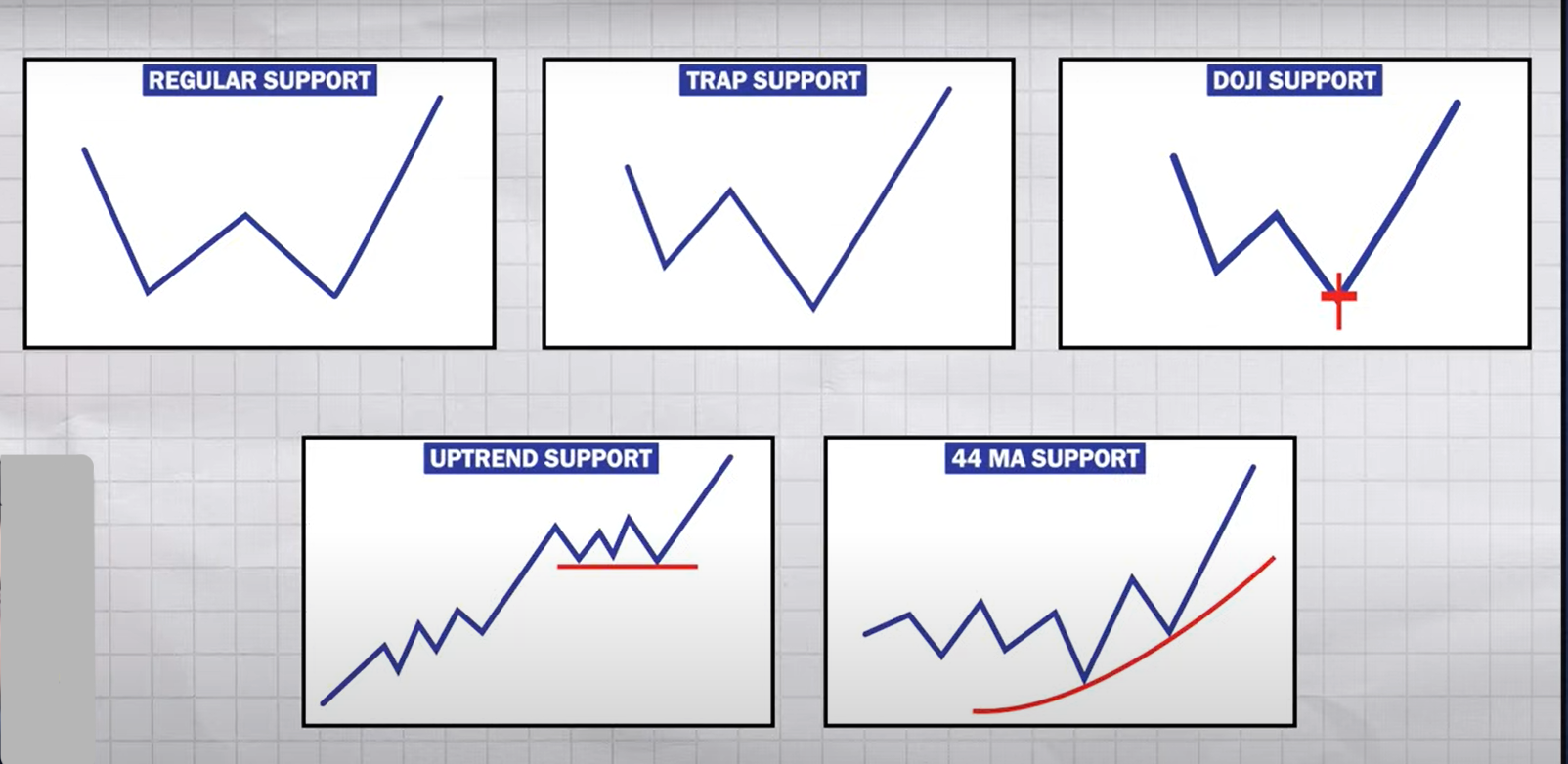
Top 5 Support and Resistance Structural Models
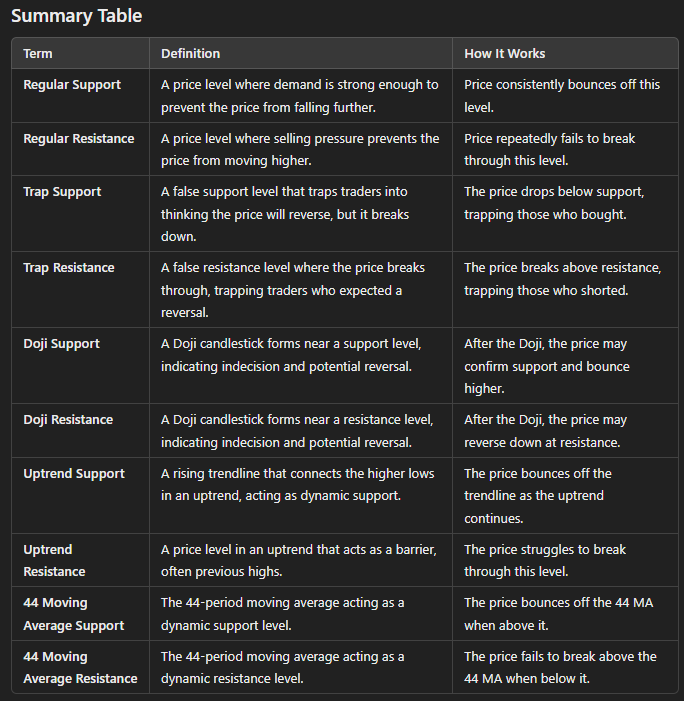
Visual Summary- Regular Support & Resistance: Horizontal swing levels holding steady volume.
- Trap Support & Resistance: Liquidity wicks designed to stop out retail orders.
- Doji Support & Resistance: Equilibrium candles signaling impending reversal.
- Uptrend Support & Resistance: Diagonal dynamic trendlines guiding market trends.
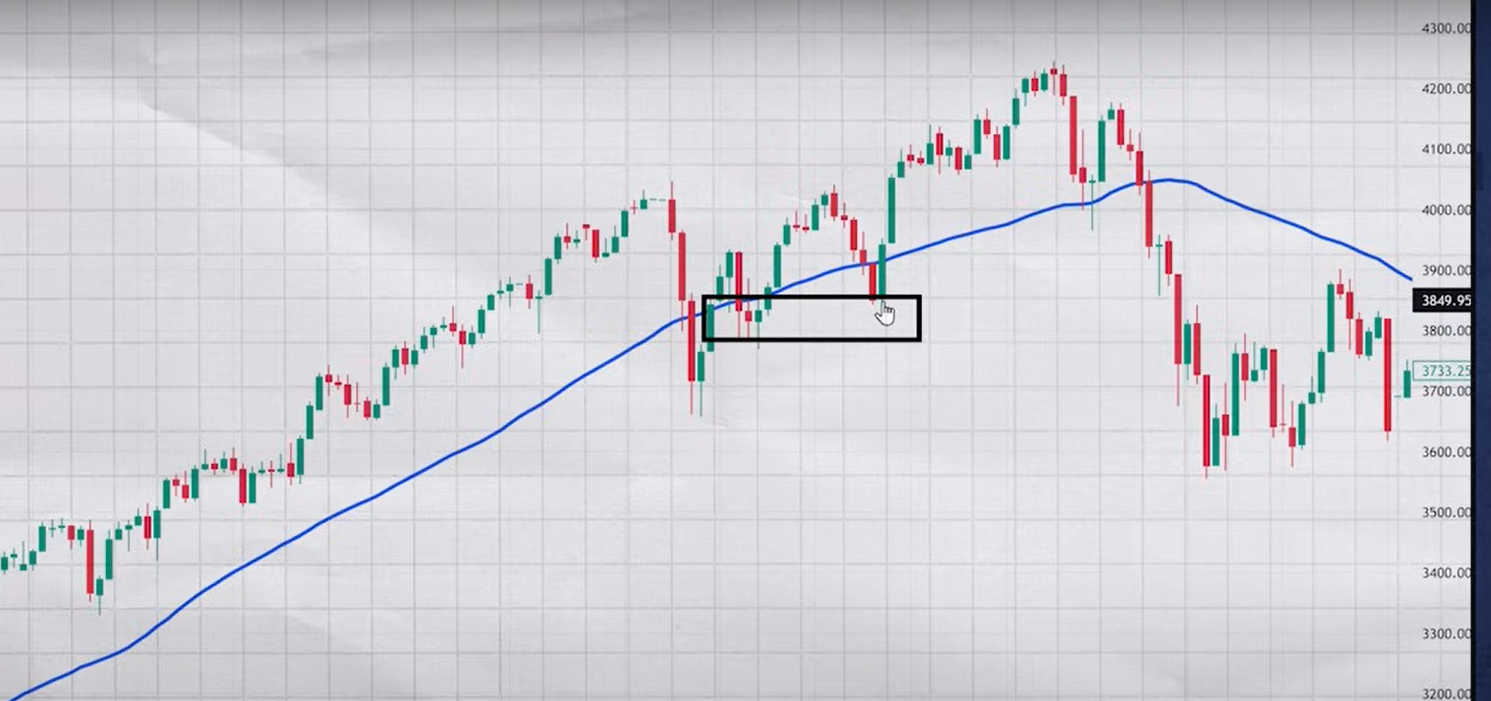
- 44 Moving Average Support & Resistance: Dynamic institutional moving average buffer.
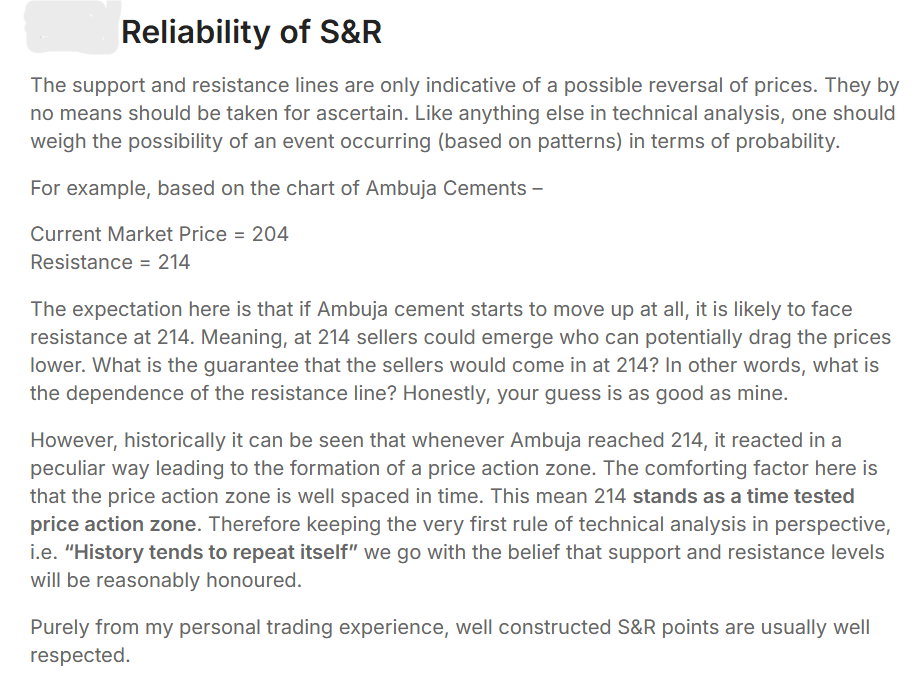
S&R Reliability Factors
- • Number of Touches: More touches = stronger, more validated zone
- • Timeframe: Higher timeframes (Daily/4H) carry vastly more significance than 1m/5m
- • Volume: High tick volume at the level = heavy institutional commitment
- • Recent Activity: Recently formed levels are more relevant than multi-year old levels
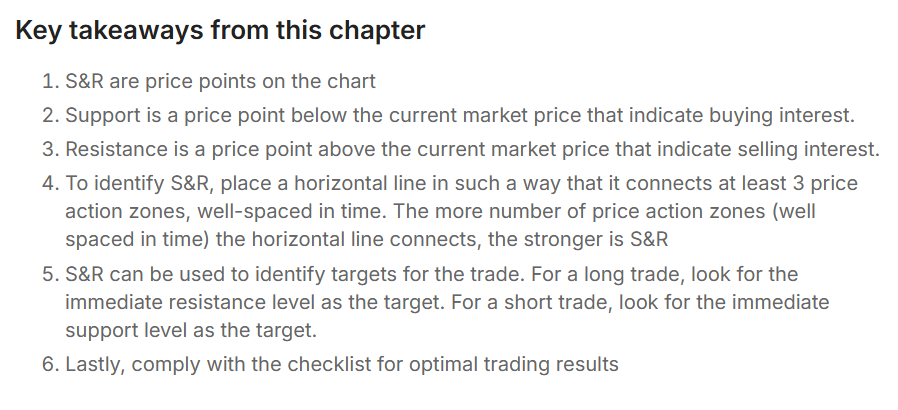
Key Trading Execution Points
- • Entry: Buy near support zones, sell or short near resistance ceilings
- • Stop Loss: Place stops beneath support for longs, and above resistance for shorts
- • Breakouts: High-volume expansion through S&R signals trend acceleration
- • Confirmation: Always wait for candle close confirmation before executing
Comprehensive Support & Resistance Taxonomy in Forex
Regular Support
Support is a price level at which a currency pair tends to find buying interest and where the price typically reverses after falling. It acts as an institutional 'floor' that prevents lower prices.
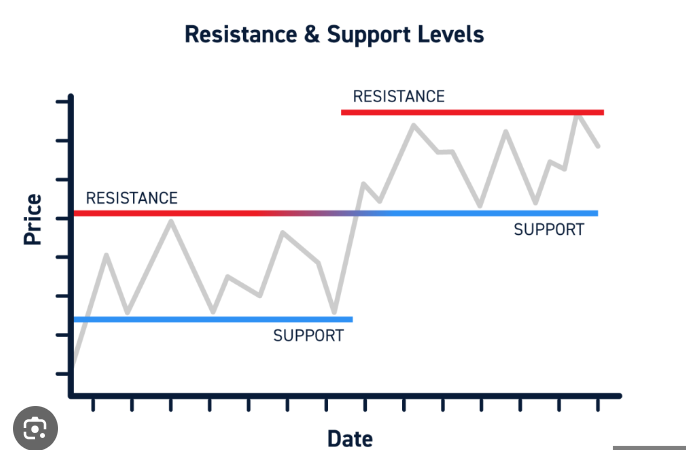
Regular Resistance
Resistance is the opposite of support. It is a price level where selling pressure exceeds buying interest, causing the currency to reverse downwards. It acts as a 'ceiling' preventing higher prices.
Trap Support (Bear Trap)
Trap support occurs when price briefly pierces beneath a major support level, trapping breakout short sellers before sharply reversing upward.
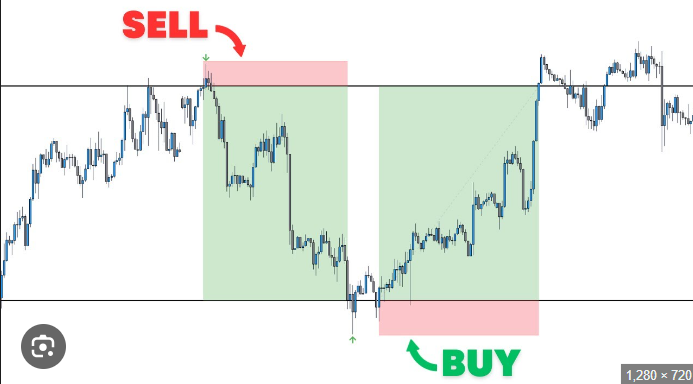
Trap Resistance (Bull Trap)
Trap resistance occurs when price temporarily breaks above resistance, enticing breakout buyers before plunging downwards.
Doji Support
A Doji candlestick forming at or near a key support floor indicates indecision and exhaustion of sellers, signaling a potential bullish reversal.
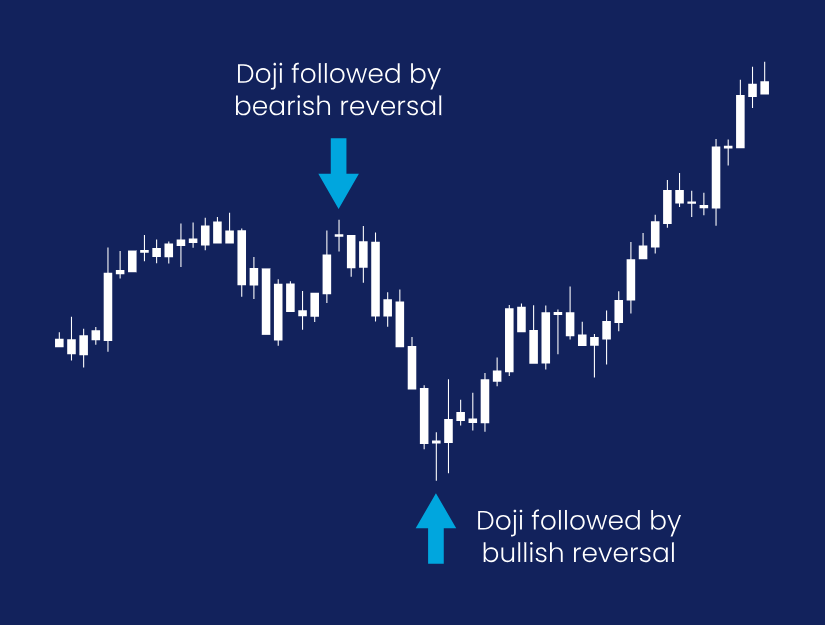
Doji Resistance
A Doji candlestick forming at overhead resistance highlights buyer exhaustion at the top of an uptrend, signaling a potential downward reversal.
Uptrend Support
In an uptrend, support refers to the dynamic trendline drawn along higher lows. It acts as a rising boundary where buying interest re-emerges.
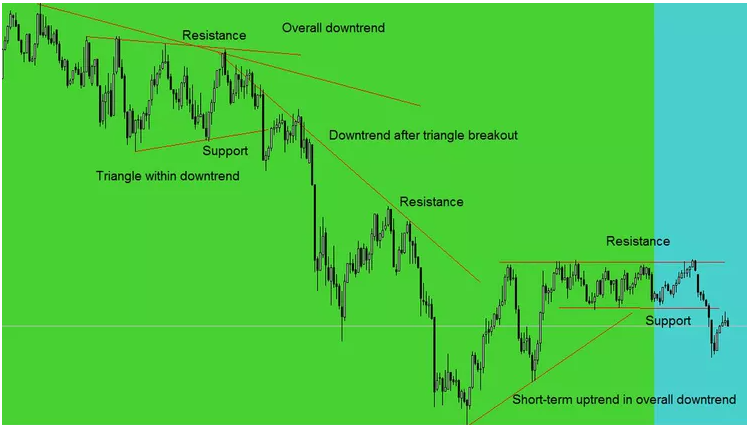
Uptrend Resistance
Resistance in an uptrend is an overhead level that price struggles to break through, usually around previous swing highs.
Downtrend Support
Lower boundary of a descending channel where short sellers cover profits and brief relief bounces occur.
Downtrend Resistance
Falling dynamic trendline connecting lower highs. Institutional sellers use tests of this falling ceiling to initiate short trades.
Moving Average Support
Key institutional moving averages (50 EMA, 200 EMA) acting as dynamic price floors during strong macro bull trends.
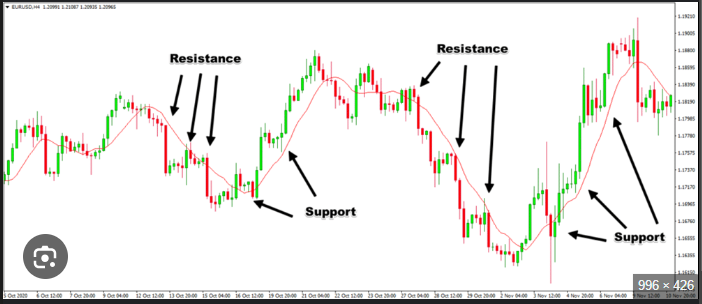
Moving Average Resistance
Major moving averages acting as overhead resistance during bear markets, repelling relief rallies.
Psychological Round Number Support
Major round figures where retail and bank limit orders concentrate (e.g. 1.0800 EUR/USD, 150.00 USD/JPY).
Master Blueprint: Top Support & Resistance Comprehensive Summary
13 Visual S&R Case Studies & Real Charts
Click to Inspect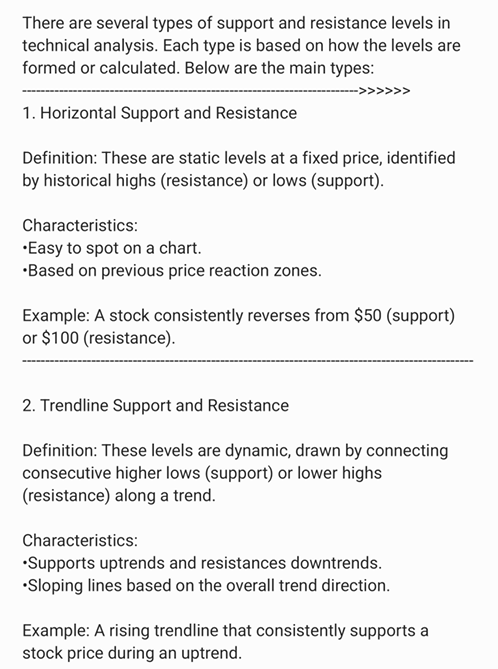
Case Study 01: Key Floor Bounce
Multi-touch demand rejection with strong bullish continuation candle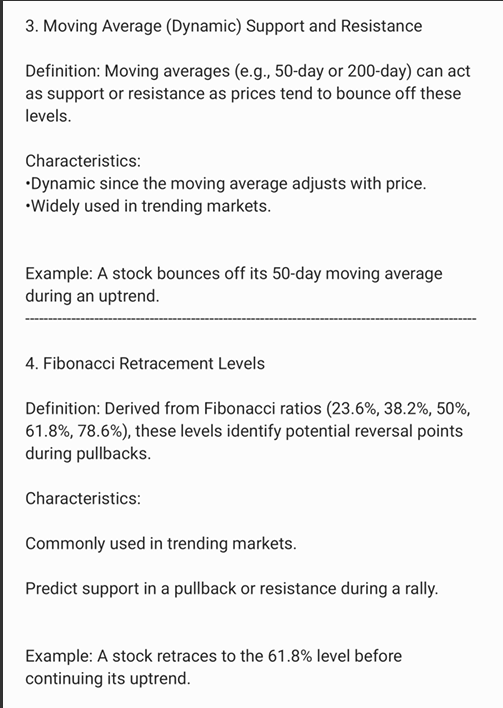
Case Study 02: Ceiling Rejection
Overhead supply absorption followed by bearish rejection pin-bar
Case Study 03: Support Breakout Breakdown
High-volume structural candle close below horizontal base
Case Study 04: Role Reversal Retest
Former ceiling flips into new rock-solid demand cushion upon pullback
Case Study 05: Liquidity Trap Sweep
Wick hunt below support level trapping early short sellers before reversal
Case Study 06: Ascending Channel Support
Diagonal higher-low trendline bounce in alignment with bull trend
Case Study 07: Range Bound Oscillation
Equilibrium trading between well-defined upper and lower horizontal boundaries
Case Study 08: Moving Average Dynamic S&R
Institutional moving average serving as sloping dynamic support
Case Study 09: Double Top at Resistance
Two successive failed attempts to breach resistance sparking downtrend
Case Study 10: Double Bottom at Support
Bullish W-formation reversal with high-volume breakout confirmation
Case Study 11: Trendline Fakeout Trap
False breakout beyond diagonal boundary resulting in rapid snap-back
Case Study 12: Price Gap Retest Zone
Sunday market open gap acting as strong institutional liquidity magnet and support