Stock Market Learning Index
Complete guide to master stock market trading with color-differentiated, structured modules.
Foundation & Technical Analysis
8 ModulesStock Market Basics
What is stock market and how it works?
Market Terms
All important market terminology
Trade Types
Intraday, delivery, BTST & swing
Trading Styles
Scalping, momentum, position trading
Candlestick Patterns
Bullish, Bearish & Continuation patterns
Chart Patterns
Technical chart patterns and breakouts
Support & Resistance
Key price levels & supply-demand zones
Market Analysis
Technical, Fundamental & Price Action
Advanced Concepts & Derivatives (F&O)
6 ModulesFutures & Options
Derivatives ecosystem & F&O overview
Futures Trading
Margin, lot size, expiry & contracts
Options Trading
Calls, Puts & option payoff strategies
Options Buying
Call & Put buying, Greeks, time decay
Options Selling
Premium collection & writing strategies
Smart Money Concept
Order blocks, liquidity pools & fair value
Options Trading & Matrix Analysis
Master the option chain matrix, Option Greeks, strike classification (ITM, ATM, OTM), Open Interest support/resistance, and Put-Call Ratio (PCR) sentiment indicators.
10 Key Concepts for Options Traders
A comprehensive checklist of skills and principles required before deploying capital in options.
Understanding the Basics
Options Terminology: Know key terms like calls, puts, strike price, expiration date, premium, intrinsic value, and extrinsic value. Options Pricing: Understand factors affecting options pricing, including the Greeks (Delta, Gamma, Theta, Vega, and Rho).
Market Research & Analysis
Fundamental Analysis: Study underlying financials, industry trends, and macroeconomic indicators. Technical Analysis: Use charts, patterns, and technical indicators. Volatility Analysis: Monitor implied volatility (IV) and historical volatility to assess market sentiment.
Strategy Development
Bullish: Long calls, bull call spreads. Bearish: Long puts, bear put spreads. Neutral: Iron condors, straddles, strangles. Volatility Plays: Calendar spreads, Vega-sensitive trades. Match your strategy directly to your risk tolerance and volatility regime.
Risk Management & Sizing
Position Sizing: Avoid over-leveraging by risking only a small portion of your capital on any single trade. Stop-Loss and Exit Strategies: Predefine your loss limits and profit targets. Hedging: Use options to hedge your portfolio against adverse market crashes.
Time Management (Theta)
Options are strictly decaying assets due to time decay (Theta). Plan trades with clear understanding of how weekends and approaching expiration accelerate premium loss.
Capital and Liquidity
Ensure sufficient margin capital, especially for options selling and multi-leg spreads. Trade liquid strike contracts with tight bid-ask spreads to minimize slippage drag.
Brokerage Platform & Tools
Choose a reliable trading platform with real-time Option Chain streaming, low execution fees, and fast algorithmic order execution.
Continuous Education
Stay updated with market news, corporate earnings, and macro inflation data. Master advanced concepts such as volatility skew, synthetic futures, and Delta-neutral adjustments.
Emotional Discipline
Avoid impulsive revenge trading based on fear or greed. Stick to your predefined risk parameters and review trade execution journals regularly.
Tax and Regulatory Awareness
Understand tax implications of speculative derivatives trading in your jurisdiction (e.g. business income turnover rules in India). Always trade within regulatory compliance.
Interactive Option Chain Matrix (Nifty 50 at ₹24,600)
₹24,600 Call Option (CE)
Directly aligned with spot Nifty (₹24,600). Maximum liquidity, Delta ~ 0.50, and highest sensitivity to Gamma and Theta decay.
₹24,600 Put Option (PE)
Directly aligned with spot Nifty (₹24,600). Balanced Delta ~ -0.50, ideal for straddle and iron condor neutral structures.
Option Buyer vs. Option Seller Payoff Dynamics
Option Buyer (Long)
LIMITED RISK- • Limited Risk: Maximum loss is strictly capped at the premium paid upfront.
- • Unlimited Profit Potential: Substantial upside if stock/index explodes past the strike.
- • Lower Capital Requirement: Small outlay compared to buying outright cash shares or futures lots.
- • Theta (Time Decay) Penalty: The option bleeds value every single calendar day if market stays flat.
Option Seller / Writer (Short)
HIGH / UNLIMITED RISK- • Limited Profit: Maximum possible reward is strictly capped at the premium collected upfront.
- • Unlimited Risk: Uncapped losses if the underlying moves violently against the position.
- • High Margin Required: Brokers require substantial collateral margin (SPAM + exposure margin).
- • Theta (Time Decay) Advantage: Time decay is the writer's best ally, draining extrinsic premium each day.

The Option Greeks: Forces Governing Option Premiums
Delta (Δ)
Measures change in option premium for every ₹1 change in the underlying asset price. Calls have positive Delta (0 to 1); Puts have negative Delta (-1 to 0).
Gamma (Γ)
Measures the rate of change of Delta for every ₹1 move in the underlying. Highest for At-the-Money (ATM) options.
Theta (Θ)
Measures daily erosion in option premium solely due to the passage of time. Always negative for option buyers, positive for sellers.
Vega (ν)
Measures change in option price for a 1% shift in Implied Volatility (IV). Both Call and Put buyers benefit from rising Vega.
Nifty 50 Option Chain Visual Architecture
Examining real exchange layout: Calls on the left, Strike in the middle, Puts on the right.

Put Call Ratio (PCR) Analysis & Reversal Zones
The Put Call Ratio (PCR) is a contrarian indicator used by institutional market makers to detect extreme retail sentiment bubbles:
PCR is within healthy equilibrium (0.7 to 1.3). Market respects standard technical trendlines and range boundaries without extreme sentiment skew.
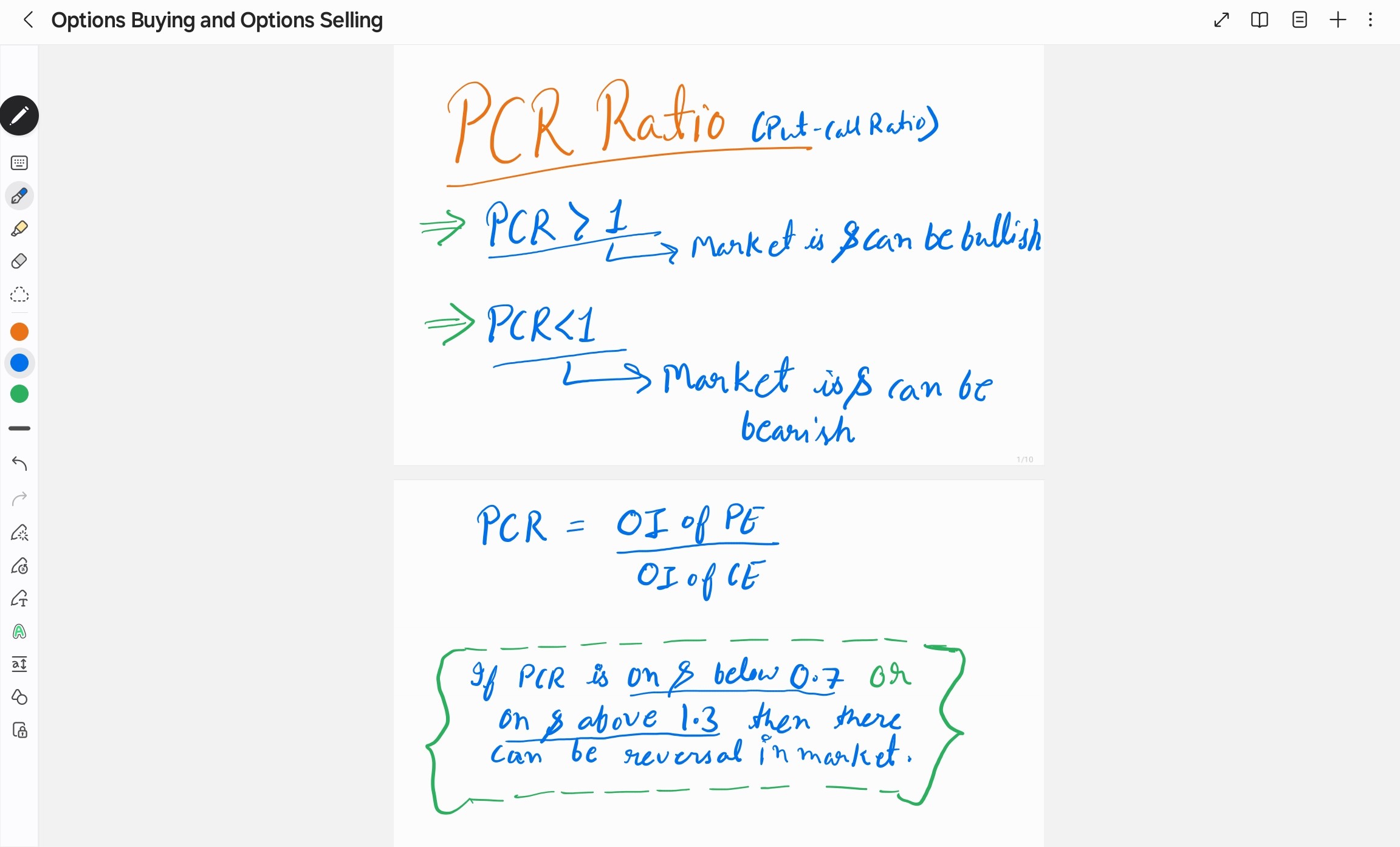 PCR Formula & Zones
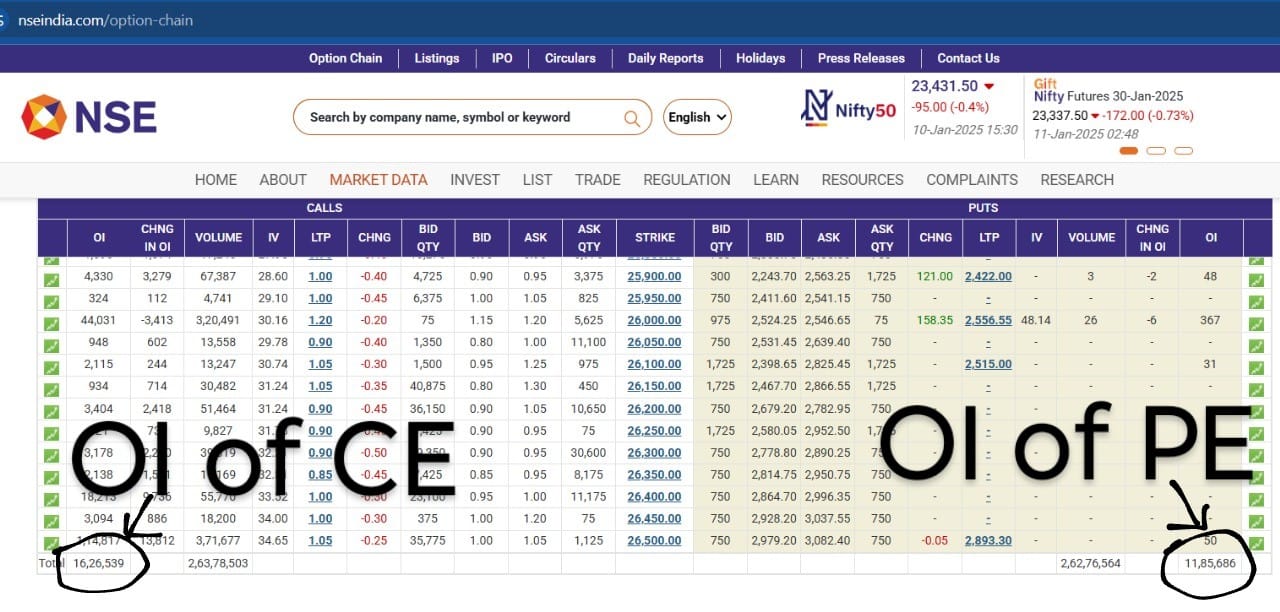 OI Distribution
Options Trading Payoff Matrix & Greeks Strategy Tables
Use these institutional cheat sheet tables to instantly cross-reference strategy requirements, directional expectations, maximum risk/reward limits, and optimal Greek exposures before placing orders.
Option Position Payoff & Breakeven Matrix
Detailed breakdown of Call Buyer, Call Writer, Put Buyer, and Put Writer directional views, breakeven formulas, and risk limits.

Options Greeks Sensitivity & Strategy Selection Matrix
Cross-referencing Delta, Gamma, Theta, and Vega across bull, bear, volatile, and rangebound multi-leg option combinations.
